For three years I worked on Disney Parks' Food & Beverage digital team, shipping four products used by tens of millions of guests order and reserve food at the parks.
Disneyland Resort and Walt Disney World together welcome nearly 87 million guests a year. My team sat at the intersection of hospitality and mobile product — designing experiences for guests who are hungry, on their feet, and surrounded by more exciting things than their phones.
iOS · Android · 2017
Mobile Order Launch
As park attendance climbed, so did food lines. My team saw an opportunity to let guests order ahead from their phones — and ship it fast.
Quick-service restaurant wait times were among the top guest complaints at both parks. My team identified mobile ordering as a high-leverage opportunity to reduce friction and free up guest time — without adding operational complexity for park restaurants.
How might we let guests order food without waiting in line?
Lines eating into park time
With 28.6M Disneyland visitors and 58.4M at Walt Disney World annually, even short food waits added up — pulling guests away from what they came for.
MVP-first, iterate fast
Focused priorities on getting core ordering functionality shipped. Finalized UX deliverables, supported engineering handoff, and led QA before launch. Additional features queued in the backlog.
Consistent month-over-month growth
Mobile Order launched in 2017 and grew steadily at both parks. Guests reported saving significant time by ordering while in ride queues or moving between attractions.
Launch screens / flow
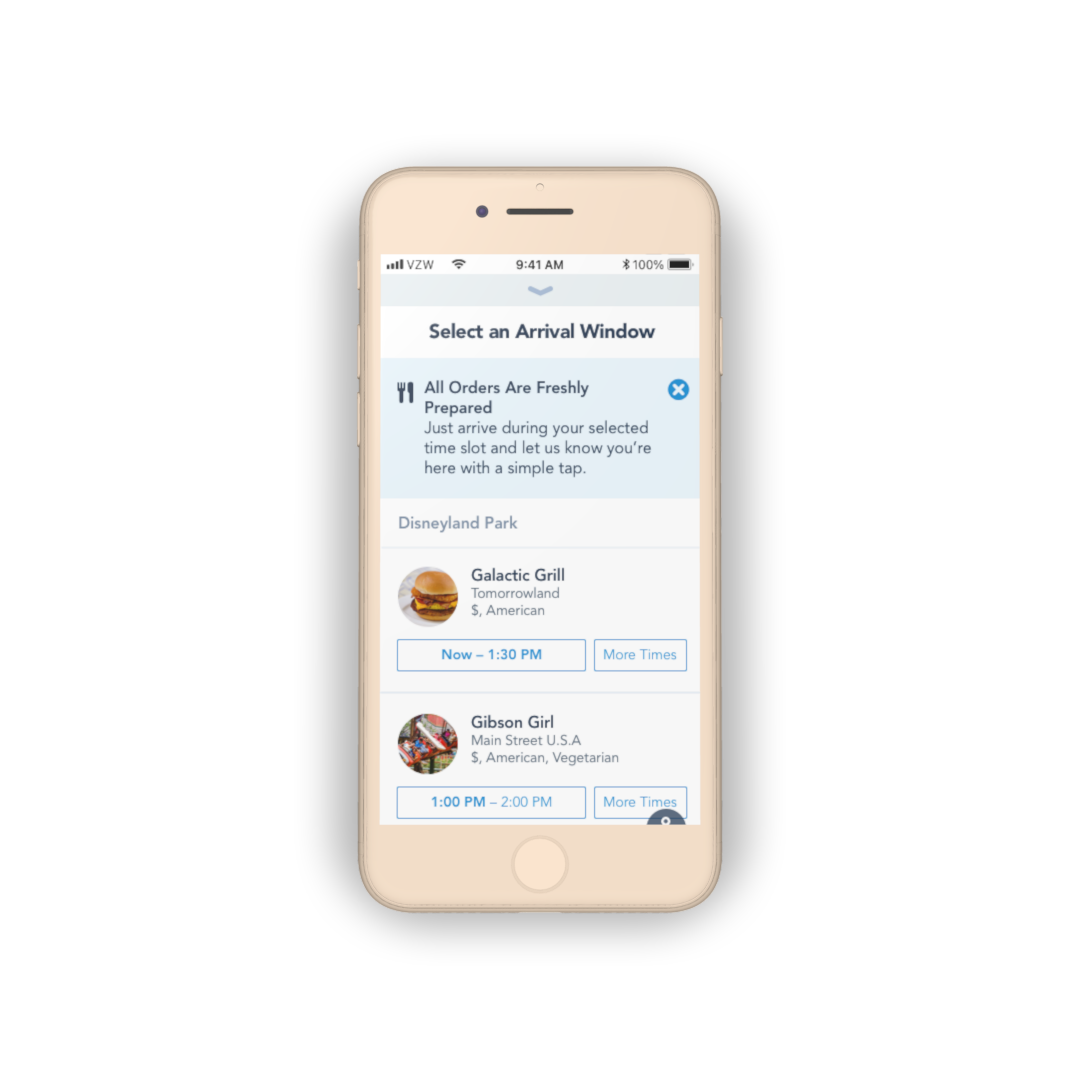
Interaction Designer — UX flows, comps, and documentation. Engineering support and QA before go-live.
iOS · Android · 2018–2019
Mobile Order Menu Redesign
Post-launch data had a clear verdict: the menu was broken. No navigation, no images, no way to browse quickly on the move.
After launch, my team began tracking user data and feedback. Guests pointed to the Menu as the biggest pain point — it lacked both navigation and food photography. The only way to see what an item looked like was to tap into its detail page, a frustrating pattern for anyone browsing in a busy park.
How might we make mobile ordering easier and more enjoyable for our guests?
Finding the focus
A workshop and audit of the existing menu aligned us on three priorities:
- 01 Navigation — Users should be able to easily browse between all menu items and category variations across available restaurants.
- 02 Visuals — The MVP had no food photography on the menu. Without images, fast browsing — especially on the move — was nearly impossible.
- 03 Brand identity — Mobile Order should feel fun and whimsical. We wanted to bring a distinctly Disney quality into the product itself.
I created three interaction patterns to evaluate with leadership and product before narrowing to test:
Dropdown
Each menu category becomes a collapsible section — letting users jump between categories without excess scrolling.
Carousel
Category navigation anchors to the top of the page as the user scrolls — always present, always one tap away.
Hub & Spoke
A hub page lists all categories; tapping one leads to a focused page of items. Cleaner structure, one extra step.
Concept 1
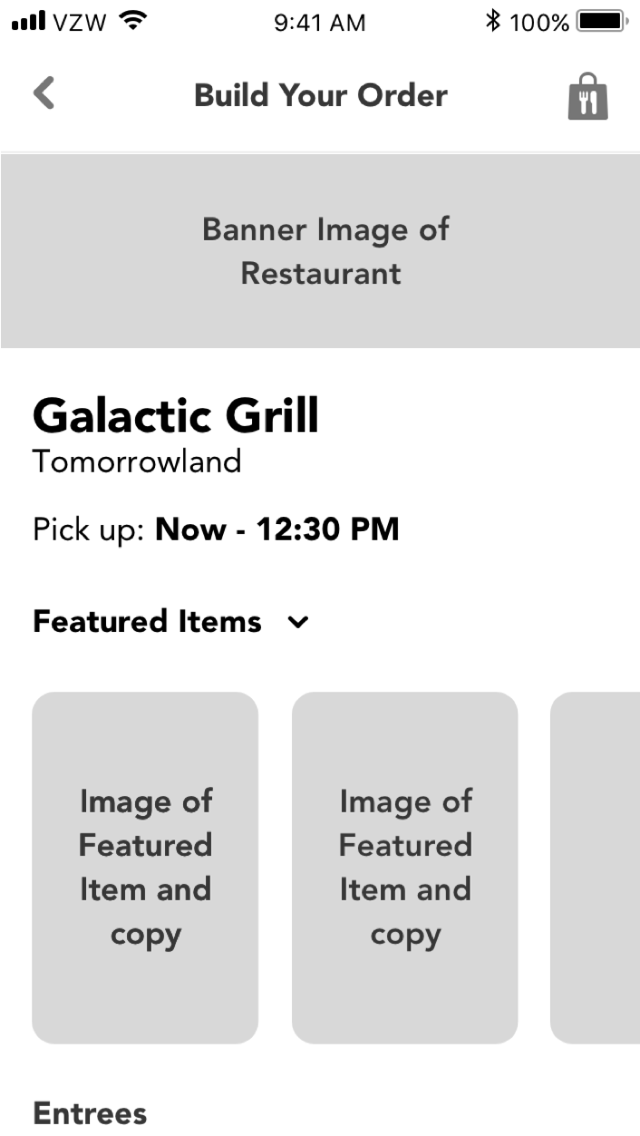
User testing at Walt Disney World
Dropdown was removed for being too similar to Carousel. I built interactive prototypes for the remaining two and loaded them onto iOS devices for in-park testing. My team flew to Walt Disney World to meet guests in their natural environment.
Every single tester chose the Carousel — and for the same reason: it encouraged immediate browsing and made it easy to jump between categories without losing your place.
— Research debrief notes, Walt Disney World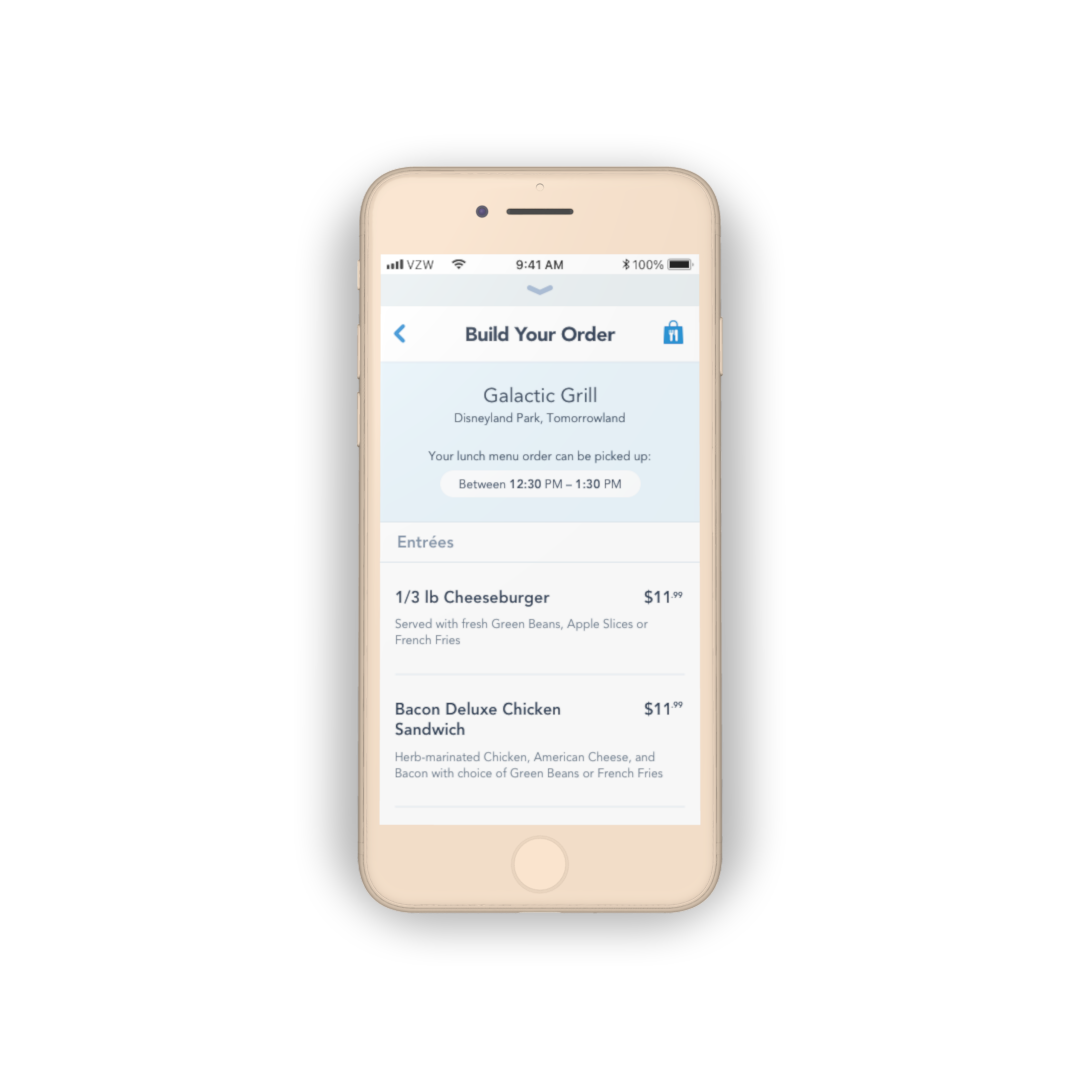
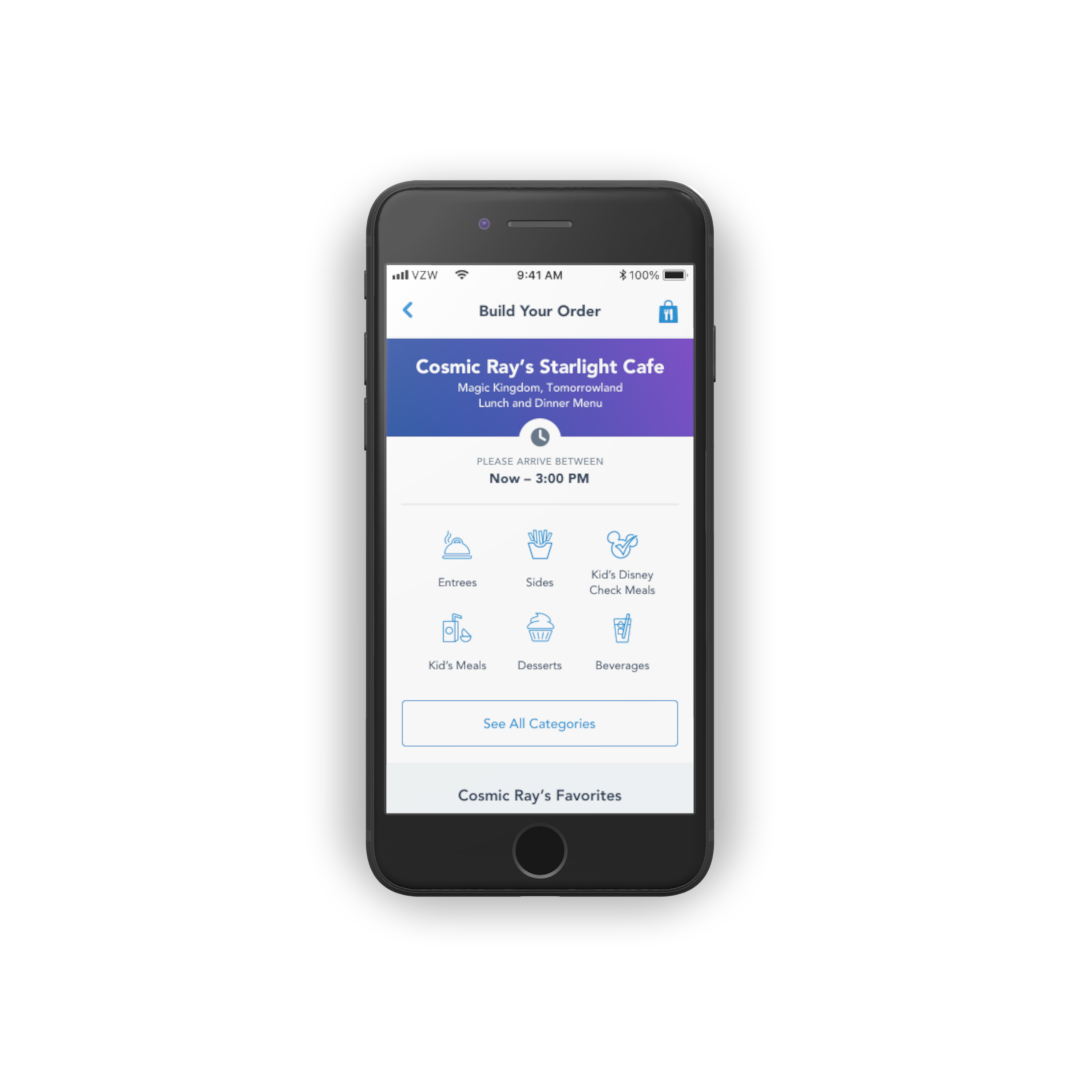
The Menu Redesign launched at both parks in February 2019 and was covered by the Disney Parks Blog and WDWNT.
Product Designer — owned all deliverables: user flows, concepts, final comps, prototypes, motion studies, and documentation. Established the visual direction for the menu category icon set. Traveled to Orlando for user testing and built the cross-functional relationship with the WDW product and engineering teams. Worked alongside one Lead Designer and one Senior Designer.
iOS · Android · 2019–2020
Mobile Order State Enhancements
Usage was up. But food was being wasted. Guests weren't picking up their orders — and the pickup flow wasn't communicating clearly enough to help them.
In 2019, tracking data revealed a pattern: guests weren't collecting orders in time after they were ready. Park restaurants — the Mobile Order stakeholders — reported a surge in unclaimed meals that had to be discarded per health code, creating food waste and operational strain.
Confused by the flow
Guests often didn't understand the pickup instructions or what the progress bar states meant. Even those who understood it said state changes were too subtle.
Operational waste
Restaurants reported a spike in unclaimed meals being discarded per health code — waste that scaled directly with Mobile Order's growing usage.
Make it worth watching
The average Mobile Order completes within minutes. The design challenge: keep guests engaged and watching their status without it feeling like a chore.
Storyboarding a narrative
The existing pickup flow used static states for instructions and order status. I proposed replacing it with a narrative animation — a short "story" that wove pickup instructions and order status into a single, delightful sequence guests would actually want to watch.
Initial storyboards were abstract, but the idea resonated immediately with leadership. I enlisted a Visual Designer to flesh out the storyline and produce the final animations.
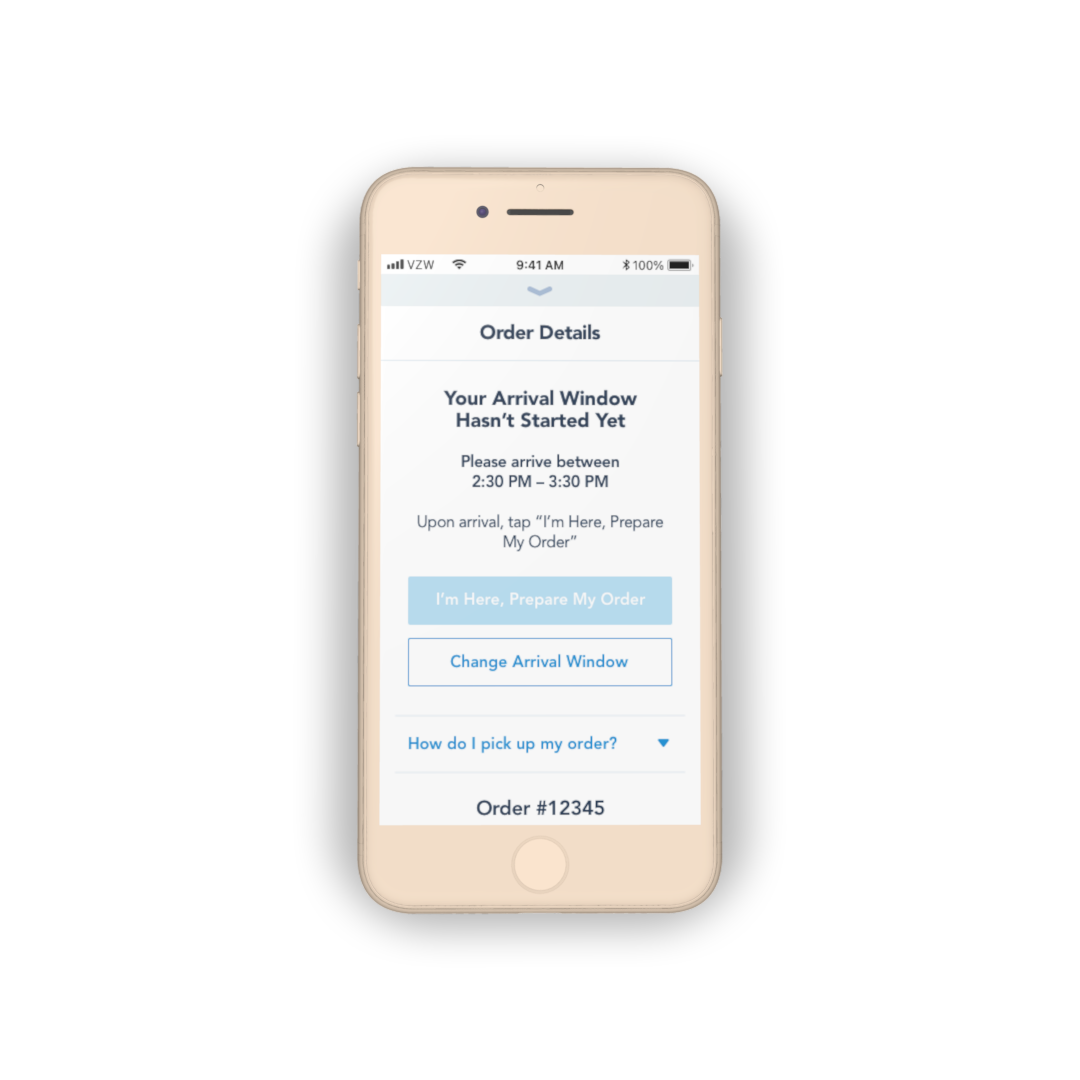
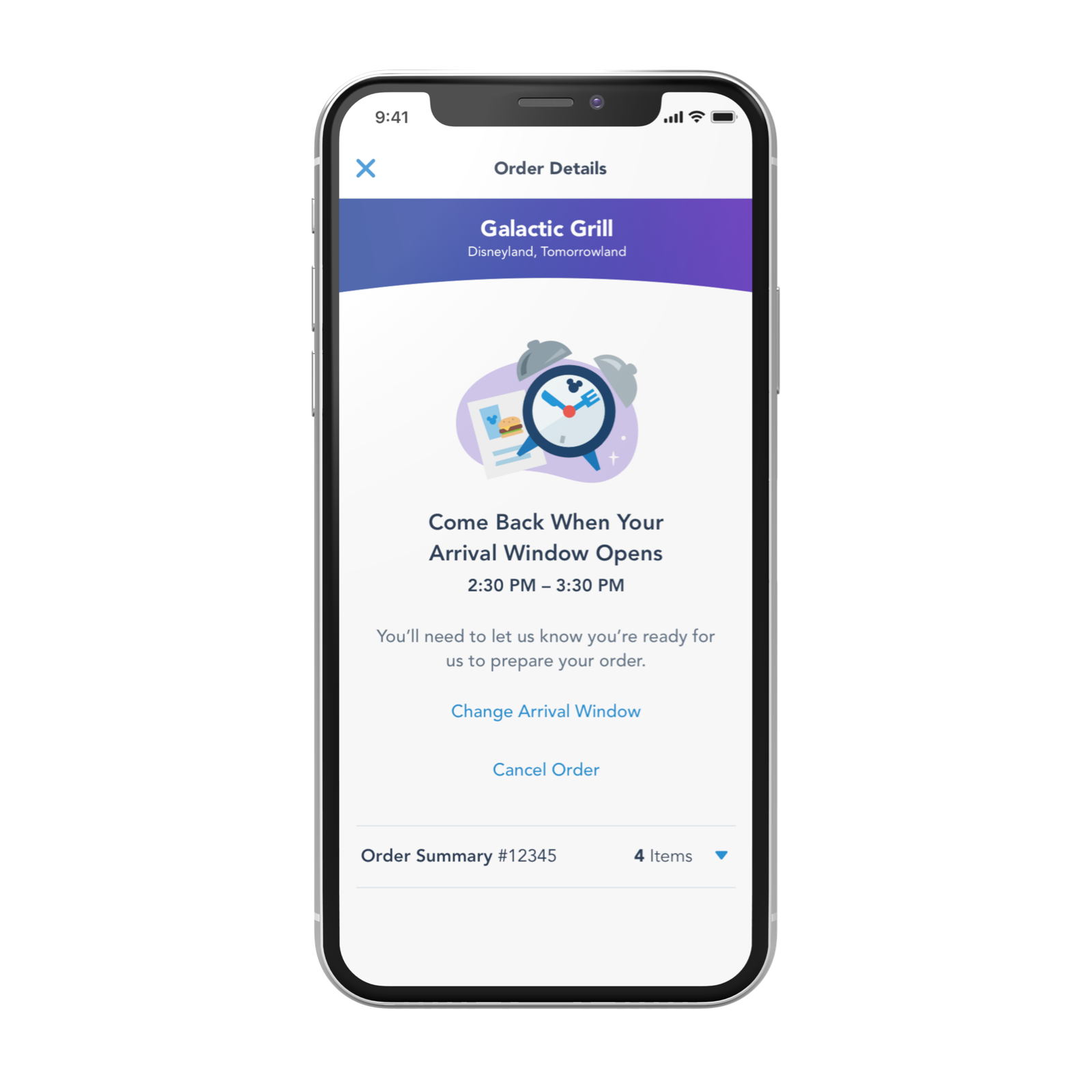
State Enhancements shipped in Q1 2020. Early feedback confirmed guests found the new experience significantly clearer and more enjoyable. The Parks closed due to COVID-19 within weeks of launch, cutting off the data needed to measure long-term impact on pickup rates and food waste.
Product Designer — owned designs from concepting through documentation. Created stakeholder presentations and pitched to leadership. Beyond design, I managed cross-functional coordination: project planning, budgeting projections, resource allocation, and weekly syncs with product and engineering. Collaborated with one Design Lead and one Visual Designer.
Web · 2019
Dine Reservation Add-Ons
Guests celebrate milestones at Disney every day. But to add a birthday note to their dinner reservation, they had to call us.
Disneyland and Walt Disney World have 40+ full-service dining locations between them. Reservations are required at nearly all of them — walk-ins aren't accepted at the volume these parks operate. Guests plan months ahead, often around special occasions.
The existing online reservation flow only supported date, time, and party size. Any celebration customization — a birthday cake, an anniversary note — required calling Disney directly. That friction hit guests, call centers, and the business.
Enhance the reservation experience by letting guests add celebrations online — reducing call center load and creating a new upsell surface.
Unnecessary friction
Adding a birthday note to a dinner reservation required a phone call — an extra step that felt out of place in an otherwise digital booking experience.
High volume, low complexity
Agents were fielding a large volume of calls that a self-service flow could handle — pulling capacity away from more complex guest needs.
Untapped upsell revenue
Celebration add-ons are a natural upsell moment. Without a digital path, that revenue potential was left on the table every time a guest called instead of converting online.
Designing within an older system
To meet the project's budget requirements, we had to reuse as many existing components as possible — which meant designing within an older UI platform with significant constraints. Rather than treating this as a blocker, we used it as a creative constraint: finding elegant solutions within a rigid system.
Dine Reservation Add-Ons launched in November 2019, giving guests the ability to add celebration experiences directly to their reservations online — reducing call center volume, improving the guest experience, and opening a new upsell channel for the parks.
Product Designer — end-to-end design within a constrained legacy UI platform. Worked closely with stakeholders to scope the feature within budget while maintaining a quality guest experience.
Reflection
Three years, four products,
one team.
Working on Disney's Food & Beverage digital team meant designing for an audience in motion — guests who were hungry, distracted, and surrounded by more interesting things than their phones. That constraint sharpened everything: every tap had to earn its place, every state had to be unmissable, and the experience had to feel unmistakably Disney.
Across four products and three years, my role grew from finalizing someone else's UX work to owning projects end-to-end — from stakeholder alignment and budgeting to in-park user research and engineering handoff.